
Have you ever faced the awkward challenge of finding a restroom during outdoor activities? From enduring half-hour queues amidst the massive crowds at music festivals and suffering the stench of crude Portable restroom trailers at construction sites, to dealing with the breakdown of sanitation facilities following natural disasters—these issues finally have a brand-new solution. Portable restroom trailers are transforming the landscape of outdoor sanitation services with their unique flexibility.
A Revolutionary Breakthrough in Portable Restroom Trailers
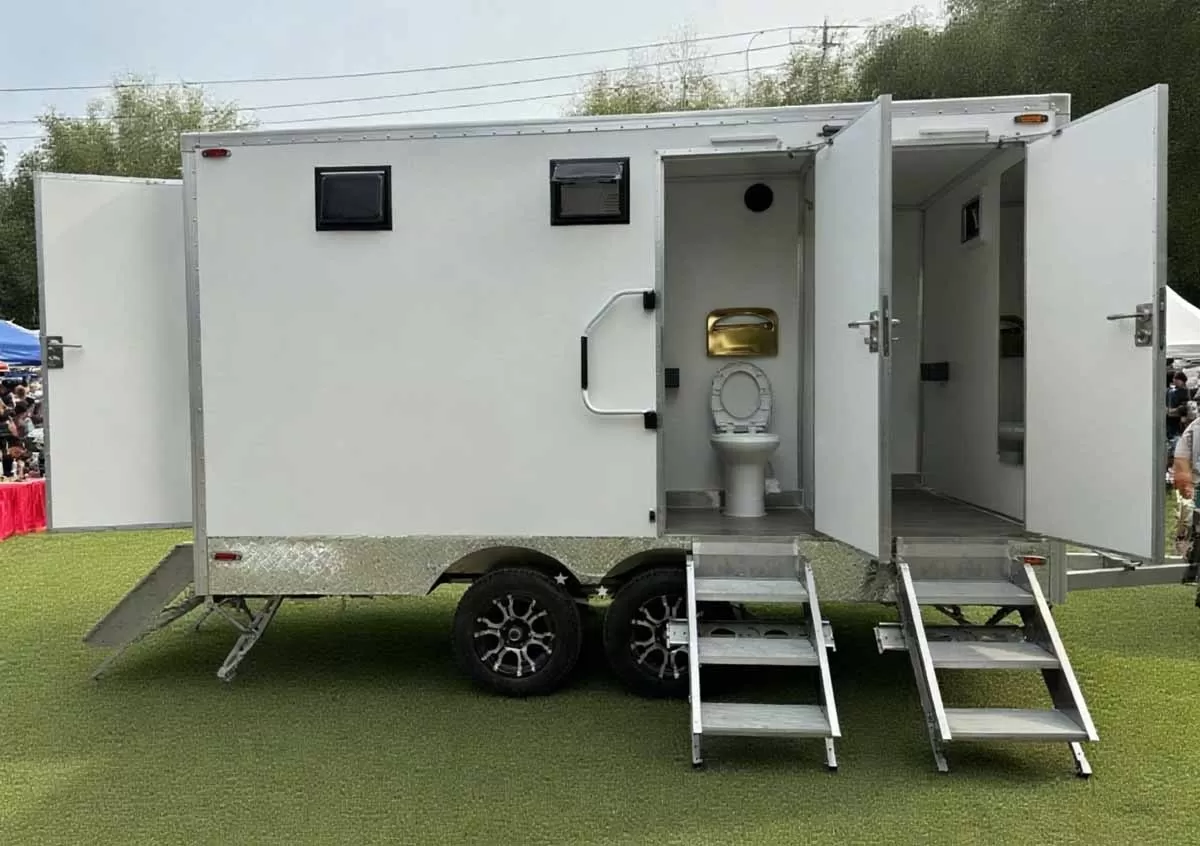
Unlike traditional fixed restrooms that rely on underground utility networks and require months to construct, portable restroom trailers offer true "plug-and-play" convenience. Built on heavy-duty truck chassis or designed as towable units, they feature independent water storage systems—typically with capacities of 500 to 1,000 liters—and integrated waste collection tanks. State-of-the-art models even incorporate vacuum-flush technology, requiring just 0.5 liters of water per flush—an 80% saving compared to standard household toilets. During the 2023 Shanghai Marathon, 30 such units served 26,000 runners, keeping average wait times under three minutes.
Compared to traditional portable toilets, the core advantage of portable restroom trailers lies in their superior mobility. Featuring an automotive-grade steel framework and an FRP composite body, they combine structural strength—capable of withstanding Beaufort scale 8 winds—with a lightweight design (curb weight of 3–5 tons). Certain flagship models innovatively incorporate GPS positioning and IoT monitoring systems, enabling managers to track 80 operational parameters in real time—such as remaining capacity and ammonia levels—thereby significantly enhancing operational and maintenance efficiency.
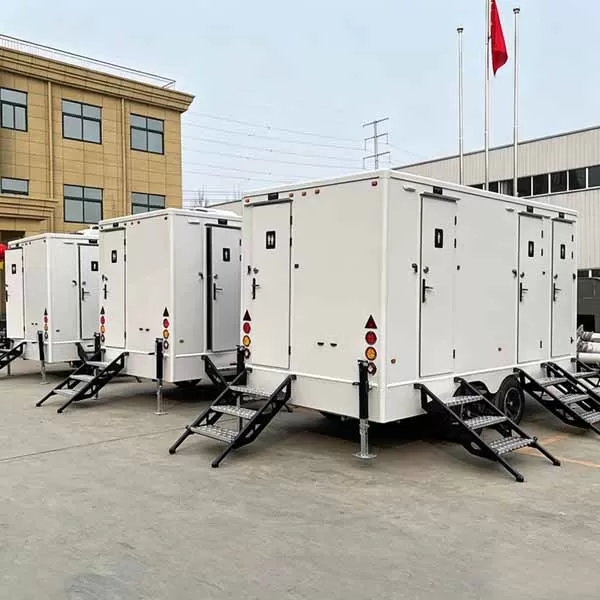
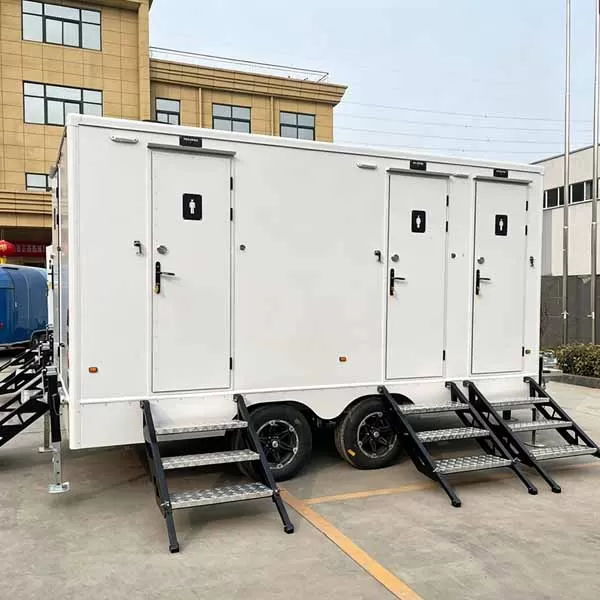
Portable restroom trailers offer practical value across a wide range of application scenarios.
Construction sites represent a prime example; following the deployment of these trailer-mounted units at a subway construction project in Beijing, workers' restroom break times were reduced by 60%, and sanitation-related complaints at the site dropped to zero. Equipped with a waterless, biodegradable waste treatment system, the units process waste on-site without the need for external discharge, making them particularly suitable for environmentally sensitive areas subject to strict regulations.
Organizers of large-scale events stand to benefit significantly. The organizers of a Chengdu music festival crunched the numbers: renting 20 conventional portable toilets would cost 80,000 yuan, plus additional fees for transport and installation. In contrast, a vehicle-based solution—offered as a package deal including transport and cleaning services—cost only 65,000 yuan, while also allowing for real-time adjustments to unit placement based on crowd density heatmaps. Satisfaction surveys conducted at the event revealed that 87% of attendees rated the restroom experience as superior to that of previous editions.